

Matt is the most AI-fluent technology leader I know.
We’re outside a taco place two blocks from his office on a Tuesday in May, at one of those metal tables that wobbles. He has run his own evaluation suite for a year. He can tell you, without notes, which of his workflows degraded when a model version shifted underneath him. His engineers ship with agents and they ship well. When his CEO gets asked about AI at a customer dinner, the answer in the CEO’s mouth is a sentence Matt wrote.
He’s not eating. He’s telling me about two things that arrived in the same week.

The first was a message from his general counsel attaching the audit committee’s updated risk register, with his name against the line for AI systems risk. Not the team’s name. His. He read it twice and it seemed reasonable, because who else would it be.
The second arrived three days later, in a Slack channel he isn’t in, forwarded by a friendly product director. The company had chosen its agent platform. His CEO had made the call over dinner with a founder he’d met at a conference, and the contract was already in legal.
Matt tells me this part flatly, the way you describe something you’ve decided not to be angry about. Then he says, “I’ve spent two years becoming the person who understands this best. And I found out I’m the person who answers for it, not the person who decides it.”
What he did next, which is what I would have done
He got better at the thing he was already best at. That’s the most natural response in the world.
Matt went deeper. He rebuilt the evals. He read the model cards the week they published. He put together a genuinely excellent internal briefing on the platform his CEO had already bought, which is a sophisticated way of doing homework on somebody else’s decision.
Meanwhile a security review of agent tooling sat for six weeks.
Meanwhile two of his senior engineers lost the ability to explain a service that a third engineer had directed rather than written.
Meanwhile he had no written policy on what an agent may do without a human in the loop, so every one of his leads was enforcing a different policy from memory.
Meanwhile his best mid-level engineer, the one who was going to be his next staff hire, left, and in the exit conversation said something about not being able to see what the next three years looked like for someone at her level.
It cost him the engineer, it cost him about five months, and it cost him the thing he valued most, which was the assumption in that by building, Matt had this handled.
What he had to give up wasn’t the fluency. It was the belief that the fluency was doing something for him that it wasn’t. Being the person in the company who understood AI best felt like protection, and it protected exactly one of the six places his job was being rebuilt.
The thing that changed it was a page. He wrote three columns and took them to his CEO: decisions I own, decisions you own, decisions nobody owns. He expected the argument to be about column one. It was about column three, which was the longest by a distance, and which neither of them had ever looked at directly. That conversation moved more in forty minutes than the previous year of excellent briefings.
I didn’t have a clever thing to say to Matt at that table, and I’ve thought about why. It’s because I made a version of the same mistake in public. I built CTO Levels, a complexity model for how big the seat is, and I was proud of it, and I still am. But it answers how big. It doesn’t answer what’s now inside. I spent a long time helping people size a chair whose shape was changing while we measured it.
Expertise is not coverage. That’s the whole idea, and it’s small enough to keep.
Six questions, and one of these is yours
Here are the six. Not topics I picked because they seemed urgent, but six questions somebody can ask you this week in a room you don’t control.
What may it do alone?
You have delegated to people your entire career, and every one of them could read a room. They hesitated. They asked a clarifying question, went quiet in a meeting, cc’d somebody. That hesitation is how you found out something was going wrong before it went wrong.
Agents produce confident output at the edge of their competence and well past it, at identical tone, indefinitely, and almost none of us have written down what ours are allowed to do.
What got built?
“Making” collapsed in cost. Understanding what got made never did, and those two used to be the same activity. When METR ran a randomised trial with experienced developers working real issues in codebases they already knew, allowing AI tools made them nineteen percent slower. They believed they had been twenty percent faster. Sixteen developers, small sample I know.
The durable finding isn’t the nineteen percent. It’s the thirty-nine-point gap between how fast they were and how fast it felt.
What did you sign?
The only one of the six where the answer is a refusal. Not what should be reviewed, not what needs a second pair of eyes. But rather, what may never leave your hands. Very few people have written that list, because nobody is scheduling the conversation.
How did you decide?
When thinking was expensive, having an answer was the achievement. The answer is now free, immediate and articulate, so the achievement moved to being able to say why you kept it. Take any decision where a model was in the room and fill in four boxes:
what you asked
what came back
what you changed as a result
what you’d have concluded on your own
Most people find the fourth box empty. Ratifying a good answer is a legitimate act, but you should know which one you did.
What can you prove?
Somewhere in your stack is now a component that can get quietly worse while reporting the same version number. Nothing else you run behaves that way. You would never accept it from a database vendor, and you’re accepting it from the thing your product thinks with.
What did you tell them?
A report says what happened. A brief says what’s true and what it means for a decision that hasn’t been made yet. We have produced the first for twenty years and called it communication.
Add those six up and you get two things.
The surface you now have to defend, and reliance on things you don’t own.
Both of them land on one person with a calendar, a mortgage, and a board meeting on Thursday.
Why your CEO took the wheel
Two numbers, and they only mean something next to each other.
In June, IBM’s Institute for Business Value published a study run with Oxford Economics: two thousand C-level technology executives across thirty-three geographies, surveyed between January and April of this year. Two-thirds report being held accountable for AI systems they do not fully control. Eleven percent believe they’re ready for the scale of agent deployment expected in the next year. The average company in that sample logged fifty-four agent incidents.
In January, BCG’s AI Radar surveyed 2,360 executives including six hundred and forty CEOs. Seventy-two percent of those CEOs named themselves their company’s primary AI decision maker, roughly double the year before.
Read them together. The accountability came to you. The decision rights went upstairs. Nobody announced it, there was no memo, it happened over about eighteen months, and now it’s the job.
The instinct is to read your CEO’s move as distrust, and getting that wrong will cost you the conversation. In the same BCG sample, half of those CEOs said they believe their own job depends on getting AI right. That isn’t a person who doubts you. That’s a person who has concluded they can’t outsource the thing they’ll be fired over. Ninety-four percent said they’ll keep investing without near-term returns, which tells you the decision isn’t running on evidence, it’s running on exposure.
You’re negotiating with somebody who took the wheel because they’re frightened, not because they think you’re slow. Those two conversations sound nothing alike, and only one of them goes anywhere.
If you don’t work this, the default is Matt’s five months. You keep deepening your best question, because it’s the one that rewards effort with a feeling of progress, and you get surprised by one of the other five. It won’t be a surprise you get to schedule.
Nine rows and a sealed envelope
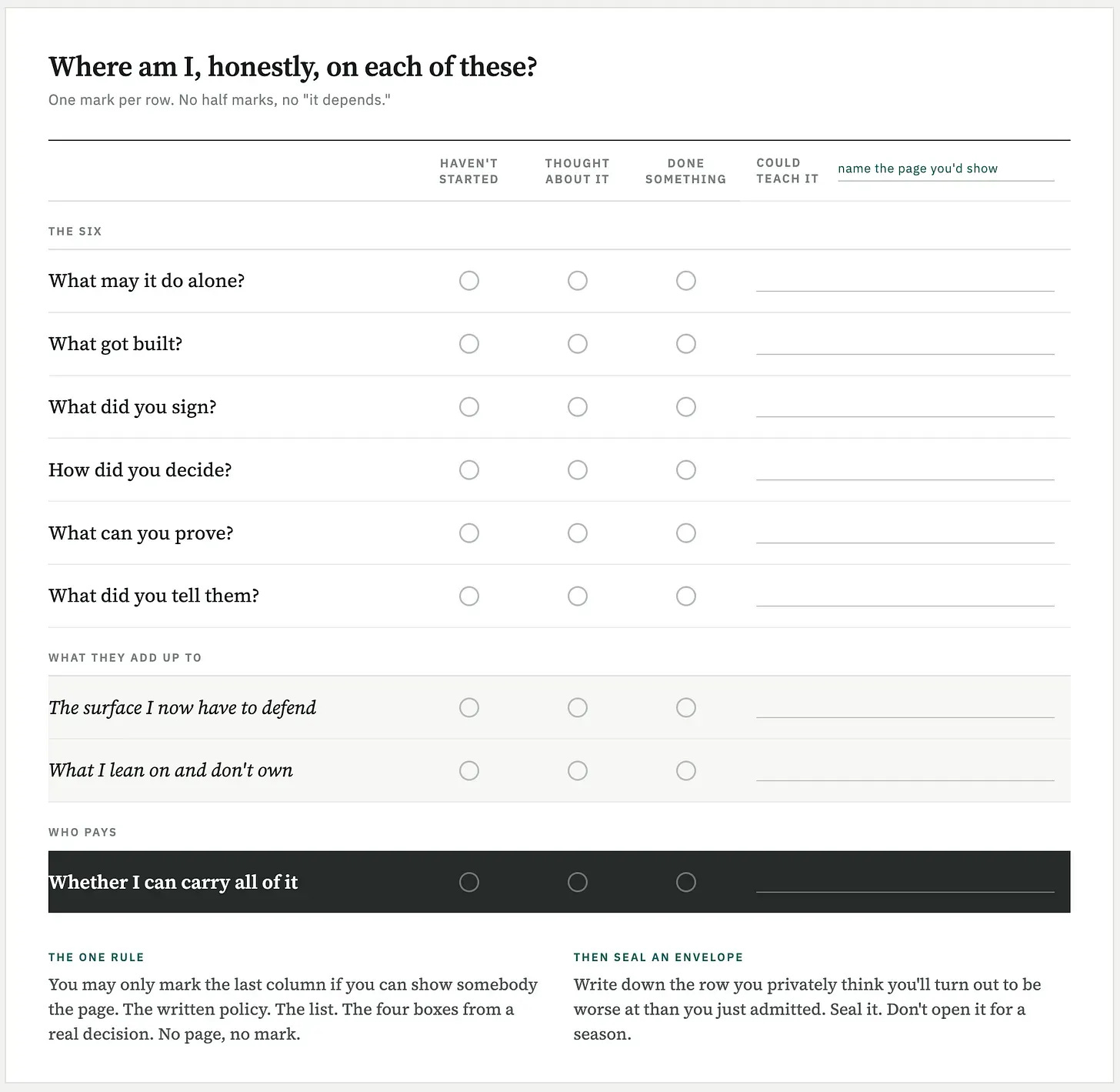
Write nine rows.
The six questions, then the two things they add up to, then you. Against each row put one of four marks: haven’t started, thought about it, done something, could teach it.
One rule, and it’s the rule that makes the exercise worth anything. You may only claim “could teach it” if you can show somebody the page. The written policy on what agents may do alone. The list of what will never leave your hands. The four boxes from a real decision. No page, no mark. Most people who do this honestly can defend one row out of nine, and I include myself in that
.
Then the second part, which is the one people tell me about months later. Take an envelope, write down the row you privately think you’ll turn out to be worse at than you just admitted, seal it, and don’t open it for a season. The gap between what you marked and what you sealed is the most accurate self-assessment you’ll produce this year.
Third, have Matt’s conversation. Three columns, and go in expecting the argument to be about what you own. It won’t be. Column three is where your next incident is living right now, unowned and unfunded, and you’re probably the only person who can see it.
Expect the first day to feel bad. Nine rows with one honest mark reads like a performance review you wrote about yourself. It stops feeling that way quickly, because a specific gap is a workable object and a general unease is not. What replaces the unease is narrower and far more useful. Not “am I behind,” which is survivable, but “I am answerable for six things and I have a page for one of them,” which is a Tuesday’s work.
You can’t slow this industry down. One CTO can’t. But those nine rows fit on a page and take ninety minutes with your own leadership team, and the first time you run it you’ll find that the six of you are ahead in six different places and have never once said so out loud.
That’s the trade, and it’s the only honest argument I have for doing this in a room instead of alone. Nobody I know is ahead on all six. Everybody I know is ahead on one. I’m running it as nine sessions with a cohort of CTOs this autumn, and the first hour is nine people writing nine rows and discovering how few they can defend.
Matt can defend three now. He’ll tell you which three, and he’ll tell you the other six without being asked, which is the part that took two years and one engineer to learn.
Etienne
p.s. email me any time: etienne@7ctos.com