
The CTO’s Refactor
Grab my new book for 99c - today only!

A CTO friend once listened to me rattle off my week. Every architecture review, every priority debate, every hire, every 2am page. I was proud of the list. Then he said, “You realize you’re the single point of failure, right?”
It stung because it was true.
My team wasn’t slow. My processes weren’t broken. I was the throughput limit. Every decision waited on my calendar, and I had spent years mistaking that bottleneck for importance.
The hard part to admit is that I liked it. A production outage doesn’t need a strategy deck. The fix is obvious, the praise is immediate, and for a moment nobody questions your value. Crisis is the cheapest dopamine a technologist can buy. Meanwhile the work that would actually make my company stronger, the systems and the leaders that don’t need me, kept getting pushed to next week.
I have watched this pattern in nearly every CTO I coach through 7CTOs. We climb by being the person who can fix anything, and then the same instinct that got us here quietly turns us into the reason everything moves slowly. You feel needed. The company feels fragile. Both are true at once.
In code, when a system gets tangled and hard to maintain, we don’t quit and rewrite from zero. We refactor. We reorganize the internals so the thing runs cleaner, without changing what it does on the outside. The function stays the same. The structure gets healthier.
Your role as CTO is no different.
The job itself doesn’t change. You still align technology with the business, steward the budget, and build the machine that builds the product. What can change is how you engage with that function. What you hold onto. What you hand off. What you protect with your whole body, and what you finally let go of.
That is what Refactor is about. Not a productivity hack. Not a color-coded calendar. A way to redesign the role from the inside so it stops eating your evenings, your focus, and the part of you that fell in love with this work in the first place.
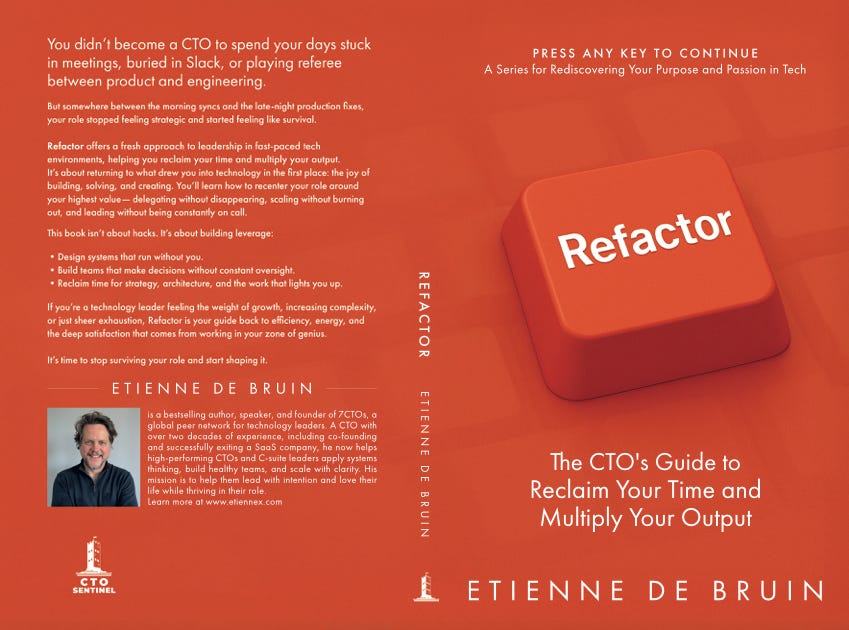
The book walks through three shifts I had to make myself, usually the hard way. Designing your role instead of inheriting it. Building leverage through people and systems instead of pouring more of your own hours into the fire. And reclaiming your time and attention as the scarce, finite assets they actually are.
I wrote it because too many brilliant technical leaders are privately unraveling while their dashboards stay green. I was one of them. The cost shows up in your health, your marriage, and the quiet question that keeps surfacing: is this really how I want to spend the next years of my life?
It doesn’t have to be.
If any of this feels familiar, the book is yours: get.ctorefactor.com
What part of your role did you design on purpose, and what part did you inherit by accident?